
for server side
Our plan today

- What is it ?
- Why using it ?
- Google journey
- Conclusion
1. What is it ?
Statically typed language created by Jetbrains
First commit 2010
Open Source: https://github.com/JetBrains/kotlin
(Apache License)
Pushed by  oogle
as the recommended language for Android since 2019
oogle
as the recommended language for Android since 2019
A language under influence
Takes the best from other languages
A language under influence
Takes the best from other languages
C# - Groovy - Scala - Swift - Java
Multiple compilation target
Multiple compilation target
- Compiled into Java bytecode and run on a JVM
Multiple compilation target
- Compiled into Java bytecode and run on a JVM
- Transpiled to EcmaScript (JavaScript)
Multiple compilation target
- Compiled into Java bytecode and run on a JVM
- Transpiled to EcmaScript (JavaScript)
- Compiled to native binaries
Multiple compilation target
- Compiled into Java bytecode and run on a JVM
- Transpiled to EcmaScript (JavaScript)
- Compiled to native binaries
- WebAssembly
Who use it on server-side ?




and many more
2. Why using it ?
Why bother with another language ?
211000 NullPointerException on GitHub
19600 duplicates on StackOverflow

“I call it my billion-dollar mistake. It was the invention of the null reference in 1965. Which have probably caused a billion dollars of pain and damage in the last forty years.”
Null reference Java vs Kotlin
                        // Java
                        final String nullableString = null;
                        nullableString.lenght(); // code perfectly valid & compiled

                        // Kotlin
                        var nullableString: String? = null
                        nullableString.length // compiler error, not allowed
                        var notNullableString: String = "Null reference is forbidden"
Designed to avoid entire classes defects
| Java | Kotlin |
|---|---|
| Nothing enforced at type system | Nullability built into the type system |
| No check at compile time | Full check at compile time |
| NullPointerException at runtime 🤞 | No NullPointerException 🥳 |
| Optional only usable for return values | Functional constructs on nullable value |
Magic syntax sugar
bye bye Lombok and Apache Utils 👋
Destructuring declarations
                        // Java
                        final var firstname = person.getFirstname();
                        final var lastname = person.getLastname();
                        final var age = person.getAge();

                        // Kotlin
                        val (firstname, lastname, age) = person
Methods overloading vs named arguments
                        void log() {
                            log("Hello world", LogLevel.INFO);
                        }

                        void log(String message) {
                            log(message, LogLevel.INFO);
                        }

                        void log(String message, LogLevel level) {
                            log(message, level);
                        }

                        void log(String message, LogLevel level, Object... args) {
                            // since Java 14
                            return switch (level.name()) {
                                case "INFO" -> log.info(message, args);
                                case "ERROR" -> log.error(message, args);
                                default -> throw new IllegalArgumentException(
                                    "Unrecognized level " + level.getName()
                                );
                            };
                        }
Methods overloading vs named arguments
                        fun log(message: String = "Hello world", level: LogLevel = LogLevel.INFO, vararg args: Any) {
                            when (level.name) {
                                "INFO" -> log.info(message, args)
                                "ERROR" -> log.error(message, args)
                                else -> throw IllegalArgumentException(
                                    "Unrecognized level ${level.name}"
                                )
                            }
                        }
Utils vs Extension functions
                        // Java
                        final class NumberUtils {
                            public static boolean isEven(final int i) {
                                return i % 2 == 0;
                            }
                        }
                        NumberUtils.isEven(2); // later in the code

                        // Kotlin
                        fun Int.isEven() = this % 2 == 0
                        2.isEven() // later in the code
Interoperability
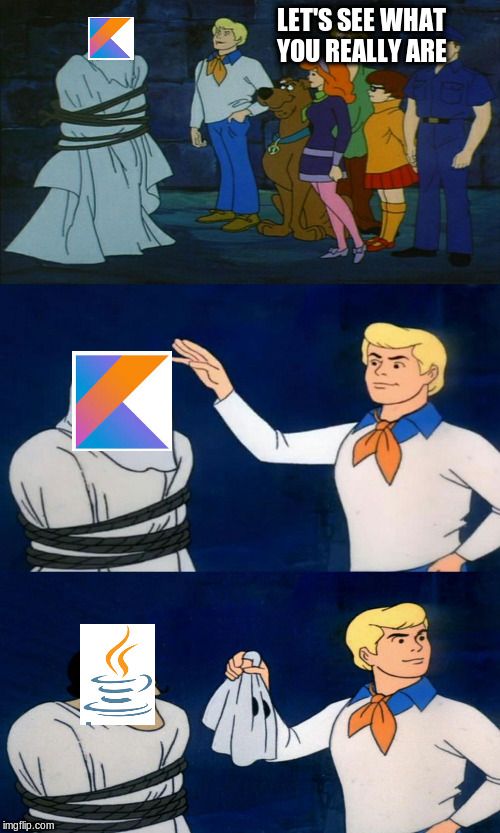
100% interoperable with Java code
                        // Kotlin
                        class AccountingService {
                            fun addTwoNumbers(a: Int, b: Int) = a + b
                        }

                        // Java
                        public class Main {
                            public static void main(String[] args) {
                                final AccountingService accountingService = new AccountingService();
                                int result = accountingService.addTwoNumbers(5, 7);
                            }
                        }
and vice-versa 😎
                        // Java
                        public class AccountingService {
                            public int addTwoNumbers(int a, int b) {
                                return a + b;
                            }
                        }

                        // Kotlin
                        fun main() {
                            val accountingService = AccountingService()
                            val result = accountingService.addTwoNumbers(3, 4)
                        }
Readability
Less boilerplate code
40% cut in the number of lines of code
Less code = less cognitive effort
Easier code to read is easier to maintain
Smooth learning curve
Few hours to read - Couple of days to produce
Makes it easier to integrate a project for newcomers
Largely Supported
Kotlin seamlessly integrates with various frameworks, offering developers flexibility and efficiency




Framework actively
supports Kotlin, allowing developers to leverage the strengths of both technologies.
Actively supported since Spring 5 (2017)
Documentation available with both Java & Kotlin examples
3. The Google example
Adoption of the language at a large scale
Worth it or not ?
Java really well implemented at Google for many years
Kotlin introduced as Java alternative for their server-side projects 6 years ago
Result: Kotlin adoption is growing quickly
Studies around the impact of the language internally

70% of devs whose primary language is Kotlin think it makes them more productive
(faster to write & language features)
87% of Google server side Kotlin devs are very satisfied with it
(easy on ramp, incremental learning & adoption)
StackOverflow survey20% less likely to crash
(Null safety, more correct code is easier to write)
0% degradation of productivity in mixed Java/Kotlin codebase
(incremental adoption, great interoperability)
4. Conclusion
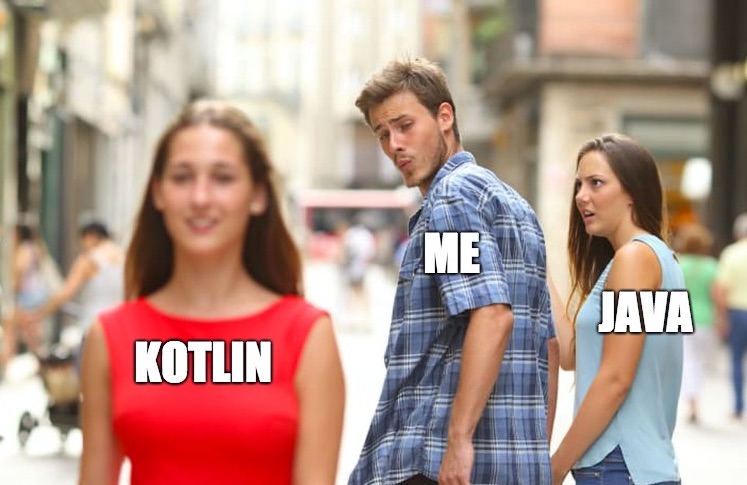
To summarize
- Makes bad choices explicit or impossible
- Less defects
- Incremental adoption (interoperability)
- Less code & code is more expressive
- Great integration with tools (Maven, Spring...)
- Elegant & beautiful 😍
A lot more cool features
(which we won't have time to cover today) 🕜
- String interpolation
- Structural equality / referential equality
- Smart casting
- Type inference
- Coroutines
- and more...
Drawback(s)
Bytecode generated at the compilation
Compilation can be slightly longer than what it is for Java
References & links
Some videos:
The git repository used for the analysis:
Some articles: